Showing posts with label Complementary Medicine's Diagnoses. Show all posts

March 16, 2013

Kanpo


Kanpo (herbal medicine)

The Japanese herbal medicine tradition developed originally from Chinese texts but, like many of the therapies described earlier in this chapter, went through uniquely Japanese stages of refinement and development. Nowadays, in Japan, only medical doctors are legally allowed to practise kanpo, yet over the counter kanpo remedies for the general public are hugely popular.

Japanese formula generally use fewer herbs than the Chinese ones and dried granular extracts are more commonly used than fresh herbal ingredients because they’re convenient and easy to take.

Kanpo diagnosis is based on eight principles described below as four pairs of opposites:

1.   Determining if the person’s symptoms are predominantly kyo (deficient) or jitsu (excess)
2.   Determining the stage of illness (chronic/acute)
3.   Ascertaining whether the disease is external and superficial or internal and deep
4.   Determining whether symptoms are predominantly hot or cold

After the predominant underlying weakness, or kyo, has been identified, it can then be treated with appropriate medicinal herbs. This approach is almost the opposite to the Western medical one, which focuses on identifying and treating the invading germ, virus, or bacteria. In kanpo, the emphasis is on supporting the weak or vulnerable parts or systems of the body to prevent them from succumbing to invading pathogens.

Because kanpo medicine focuses on an individual’s constitution and that person’s particular response to the disease, the treatment for different people with the same disease, according to Western medicine, will often be different. So, for example, if five people were diagnosed with asthma, in Western medicine they may all be prescribed the same type of inhalant medication, yet, in kanpo, their herbal medicine prescriptions, while maybe having some ingredients in common, would probably all differ.

Most kanpo formulas have five to ten ingredients. They’re usually made from plant ingredients including roots, bark, leaves, flowers, fruit, and fungi, although occasionally mineral or animal ingredients may be used. These ingredients are selected according to their individual effects on the body and also their combined effects with each other.

Kanpo herbal medicines are well researched and are regarded as safe to take, with virtually no side effects if prescribed and taken properly. If you’re pregnant, breast-feeding, or hoping to conceive you must always inform your practitioner or consult your GP before taking kanpo medicinal herbs.

You can take kanpo herbal medicines with Western medicine but ensure you’re carefully monitored by qualified and experienced practitioners in case of interactions. Always inform your GP and herbal practitioner of any medicines and herbs that you’re taking.


Complementary Medicine's Diagnoses - ...cont'd.


Diagnosis by observation (Bo-shin)

Bo-shin involves looking at the tongue and sometimes also the fingers, toes, ears, and face. The Japanese medicine practitioner examines the tongue to assess its color  shape, and coating for information about the functioning of your internal organs.

Micro-diagnosis, which involves the examination of an individual body part for information about the whole body, is also a speciality in Japanese medicine. Just as different parts of the tongue are said to correspond to various parts of the body, so too it is said to be possible to examine the hands, fingers, toes, face, ears, and so on for similar clues.


For example, in analyzing the fingers and toes, redness, red spots, and the sensation of heat in a particular digit indicate a jitsu (excess) condition in the organ to which it corresponds, while pallor, white or brown spots, or sensations of coldness can indicate kyo (deficiency).The practitioner may also take note of your gait, body size and proportions, skin, nails, hair, facial expressions, and even the color of clothes that you’re wearing as all can provide valuable clues to your current state of health.


Complementary Medicine's Diagnoses


Diagnosis by palpation (Setsu-shin)

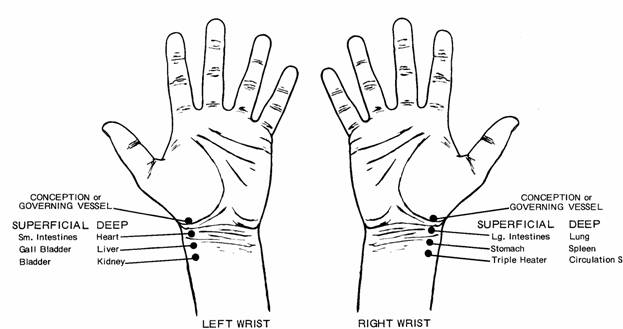
With Setsu-shin, the practitioner takes pulses on each of your wrists and may also palpate your abdomen and specific points along the meridian channels (channels of vital energy in the body. As in traditional Chinese medicine, Japanese medicine recognizes six pulses on each wrist, corresponding mainly to each of the major organs of the body.


In Japanese medicine, pulse taking has a slightly lighter touch than in Chinese medicine and the practitioner generally takes the pulses on both of your wrists at the same time, comparing the left and right sides of each pulse position with each other.

Abdominal palpation may also be used to determine the relative kyo and jitsu of all your internal organs. Master practitioner Shizuto Masunaga employed a unique form of hara (abdominal) diagnosis. This same form is used by many shiatsu practitioners and some acupuncturists today.

The practitioner palpates each area feeling for fullness (jitsu) or emptiness (kyo). A diagnosis for fullness occurs when the abdomen feels hard and often tender when pressed. In an emptiness diagnosis, the abdomen feels soft and fingers sink in without resistance.

Practitioners also often palpate along meridian lines. Again they are feeling for areas that are soft and sunken and that welcome pressure (kyo) or those that are hard and resistant and painful on pressure (jitsu). These points will form the basis of treatment in both Japanese acupuncture and massage, including shiatsu.